
If you've spent any time with SAF® materials, you've probably run into the word "dragon" used in a way that has nothing to do with fantasy novels. In SAF, a dragon is what a stored trauma is affectionately called, and the choice of word isn't decorative. It's doing real work.
A symbol older than the wound itself
Dragons appear across nearly every culture's mythology and folklore, often as a symbol of the unseen. In many traditions, the dragon was invoked for protection, worship, and instruction: a way of giving shape and presence to something powerful that couldn't be looked at directly. That's precisely the relationship most people have with an old trauma. It's rarely sitting in plain view. It shows up sideways, as an ache, a pattern, a reaction that doesn't seem to match the moment, while the actual event that created it stays out of sight, guarded.
Calling it a dragon does two things at once. It takes something that might otherwise feel shameful or frightening to look at, and gives it a bit of mythic distance, something you can approach with curiosity instead of dread. And it acknowledges, honestly, that the thing has teeth. A dragon is not nothing. It's not "just in your head." It's a real pattern with real weight, and it deserves to be treated as one before it can be worked with.
Where the term shows up
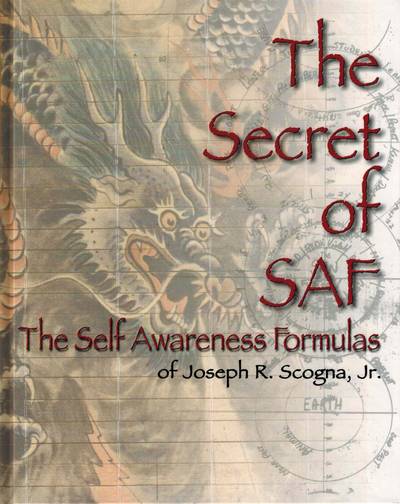
The dragon framing runs all the way through The Secret of SAF, Joseph R. Scogna Jr.'s original hardcover textbook on the methodology. The book is illustrated throughout with woodcuts of dragons through the ages, drawn from the same folklore traditions where the symbol first took hold, and it uses the dragon consistently as shorthand for a trauma waiting to be decoded rather than feared.
That decoding is really the whole premise of SAF: a symptom is a message, and a dragon is a message that hasn't been read yet. The numerical chain, whether generated through the Stress-120 questionnaire or an infrared scan, is the tool for reading it. Once a dragon has a name, a Lead, a Core, and an Anchor, it tends to stop behaving like one.
What to do when you meet your own
If you're working through your own SAF chain for the first time and it feels like you've bumped into something bigger than expected, that's normal, and it's the same thing every reader of these materials eventually runs into. Our guide to reading your first chain walks through how Lead, Core, and Anchor work together to name exactly what you're looking at. From there, SAF Simplified in our bookstore is the most accessible self-teaching companion, and a guided SAF Chain Interpretation session is available if you'd rather have someone experienced sit with you through it the first time.
Not medical advice. Not diagnosis. SAF® is an awareness tool for understanding personal patterns.